Weather Cover: The #1 Thing You Can Do
If you do nothing else in this guide, do this: cover your pit every single time it is not in use. UV radiation and moisture are the two forces that destroy landing pits faster than anything else — and a weather cover eliminates both.
Most manufacturers sell the weather cover separately, at $800–1,500 for a high jump pit. A pit that fails three years early costs $5,000–18,000 to replace, so a cover pays for itself either way — but you shouldn't have to buy it twice. Every Dropzone pit ships with a weather cover included.
What a Weather Cover Actually Prevents
- UV degradation — UV radiation breaks down vinyl and foam over time. Uncovered outdoor pits in Sun Belt states can lose 30–40% of their useful foam life in 3–4 years. A cover blocks this entirely.
- Water pooling on top — standing water on an uncovered pit seeps through seams and saturates the foam. Waterlogged foam grows mold and loses compression performance. Once it's in, it's hard to get out.
- Bird and pest damage — birds will nest in or on uncovered pits. Claws and beaks damage fabric and foam surfaces faster than you'd expect.
- Debris accumulation — leaves, dirt, and debris trap moisture and accelerate fabric wear at contact points.
Pro Tip
If water pools on top of your weather cover after rain, clear it before removal. Sliding a waterlogged cover off the pit drags water into the seams between sections. Lift the edge and let it drain first.
Common Mistake
Many programs remove the weather cover at the start of the season and leave the pit uncovered all spring. This exposes the foam to 3–4 months of daily UV for nothing — every practice and meet, the pit could be covered between sessions. Get in the habit of covering after every practice.
Off-Season Storage
What you do with your pit from June through February determines how it performs in March. Most pit degradation happens during the off-season, not during the season — because programs cover during the season and forget about the pit in the off-season.
Indoor Storage (Best Option)
If you have the space, store the pit indoors during the off-season. A field house, equipment room, or large storage bay all work. Indoor storage eliminates all UV and weather exposure and can add 2–4 years to total pit life. If the storage space is climate-controlled, even better — extreme heat accelerates foam breakdown.
Covered Outdoor Storage (Acceptable)
If indoor storage isn't available, covered outdoor storage is workable with proper precautions:
- Verify the weather cover is fully secured — wind will unseat a loose cover, leaving part of the pit exposed for weeks without anyone noticing
- Use a ground cover as well — moisture wicks upward from ground contact. A vinyl ground cover under the pit prevents this
- Check monthly — don't set-it-and-forget-it from June to February. A monthly check catches a shifted cover or pooling water before it becomes a problem
- Avoid locations with standing shade — perpetually shaded areas stay damp longer and promote mold growth in the foam
Do Not Do This
Do not store your pit on wooden pallets. Pallets are not designed for landing pits, create liability concerns (unsecured wood around athletes), and do not adequately elevate the pit above ground moisture. If moisture drainage is a concern, contact us about appropriate ground cover solutions.
Seasonal Inspection Routine
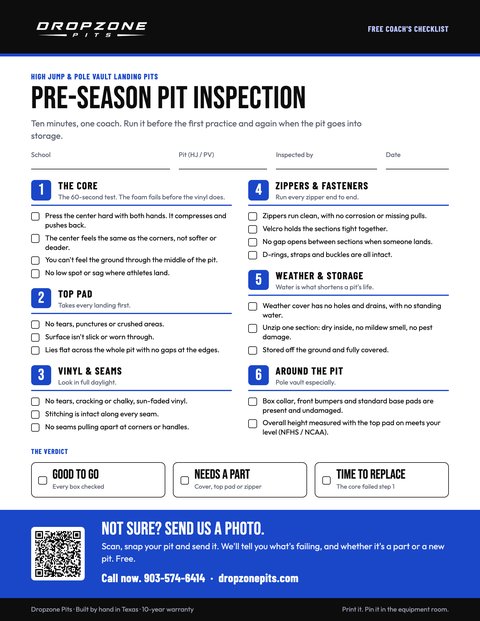
A 20-minute inspection at three points in the year catches problems before they become emergencies. The three points: before the season begins, midseason, and at season end before storage.
Pre-Season Inspection Checklist
Before First Practice
Mid-Season Quick Check
Once mid-season, do a fast check for any seam that has developed since the start: top pad wear, carabiner function, and whether the base sections are staying aligned under competition load.
End-of-Season Storage Prep
- Clean the pit surface — remove dirt, debris, and any organic material that could cause mold during storage
- Dry the pit before covering — if the pit is wet from rain, let it air dry before applying the weather cover for storage
- Document any damage found — take photos and notes of anything that needs attention before next season, while it's fresh
- Order replacement parts in the off-season — a worn top pad ordered in July ships in a week; ordered in February, it may not arrive before your season opens
In-Season Daily Practices
Before Every Practice and Meet
- Remove the weather cover — verify no water is pooling before pulling it off
- Check that all base sections are connected and aligned
- Ensure the top pad is fully attached at all carabiner points
- Clear the landing zone of any equipment, bags, or debris
After Every Practice and Meet
- Replace the weather cover — every single session, including mid-week practices
- Secure the cover fully — high winds will unseat a partially attached cover
- Check that standards and crossbar are not leaning on or contacting the pit fabric
Make It a Team Habit
The easiest way to ensure the pit gets covered every day is to make it a team responsibility — not a coach responsibility. Assign a rotation so athletes cover the pit after practice as part of pack-up. Teams that do this consistently get 20–40% more life out of their pits than those who rely on one person remembering.
Foam Care and Longevity
The foam core is the heart of the pit. It's also the most expensive component to replace and the one most damaged by improper care. Here's what you can and can't do to extend foam life.
What Helps Foam Last Longer
- Consistent top pad use — the top pad exists to take spike abuse and impact energy so the core foam doesn't have to. Never let athletes land directly on the base foam sections without the top pad in place
- Reversing the top pad — a reversible pad is reversible for a reason. Flip it partway through the season so wear evens out across both faces instead of concentrating on one
- Keeping it dry — dry foam recovers its shape; waterlogged foam does not. Everything about covers and storage above is ultimately about this one property
- Keeping it out of the sun when idle — UV reaches the foam through the casing over time. Covered between sessions, not just overnight
- Spreading the landings out — where you set the standards decides where every athlete lands. Nudging the setup laterally across a season, where your markings allow, spreads the compression instead of concentrating it in one strip
What Does Not Help
- Fluffing, beating or "airing out" the foam — compression set is a change in the foam's structure, not trapped air. Once a section has flattened and stayed flat, nothing you do from the outside brings it back
- Adding a second top pad — a pad on top of a dead core does not restore the landing. It raises the surface and hides the problem, which is worse than the problem
- Rotating base sections — tempting, but the sections are built for their positions and the Velcro security system expects them there. Ask before you reorder anything
The Five Mistakes That Cost Programs the Most
None of these are exotic. All of them are things we see on pits that came back to us years earlier than they should have.
- Leaving the cover off all spring. Covered in the off-season, uncovered every day of the competition season — three or four months of daily UV, every year, for nothing. The pit is in use for maybe two hours of that day.
- Dragging a waterlogged cover off the pit. Pulling a cover with standing water on it drags that water straight into the seams between sections. Lift an edge, let it drain, then remove it.
- Storing it on pallets. Wood does not elevate a pit meaningfully above ground moisture, and it puts unsecured timber near athletes. A vinyl ground cover is the right answer.
- Discovering a problem in February. Parts are made to order. A worn top pad found at the end-of-season inspection in May is a quiet purchase; the same pad found the week before the first meet is a scramble.
- Treating the surround as optional. Standard base pads, box collars and front bumpers are required equipment, not accessories. They get left off the requisition and then raised at inspection.
One habit beats all five
Make covering the pit a team job on the practice pack-up rotation rather than something a coach has to remember. Programs that do this consistently get noticeably more life out of a pit than programs relying on one person.
Replacement Parts
Most pits we get called about do not need replacing — they need a cover, a pad or a zipper. Seams and closures fail long before the body of a pit does, and a $400 part that keeps a good pit in service for another five seasons is the best money in this whole guide.
We build parts for pits we did not make. Covers, top pads, base pads, collars and bumpers are all made to order from your measurements, so you are not stuck because a part was discontinued or the company that sold you the pit no longer supports it.
- What we need: width, depth, and the overall height with the top pad on — that last one is the measurement most often given wrong, and it is the one that decides whether a cover fits
- Send a photo of the pit and the failed part. More useful than a paragraph of description
- Order in the off-season where you can. Same money, quieter month, no risk to your opener
Everything available is listed on the replacement parts page, or call 903-574-6414 with your dimensions.
Not sure whether it is a part or the pit?
Run the 60-second pit check first. It separates a repair from a replacement in about a minute, and it will keep you from buying a cover for a pit whose core has already gone.