Start Here: Is It a Part or Is It the Pit?
Most of the pits we get called about do not need replacing. They need a cover, a pad, or a zipper.
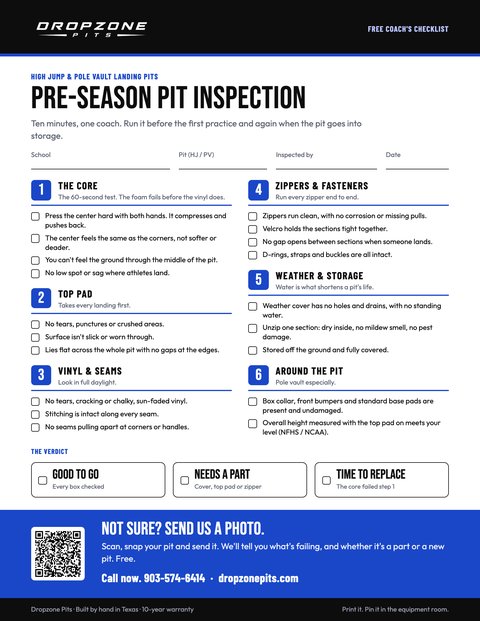
The distinction is simple enough to make yourself in about a minute. Press down hard in the middle of the landing zone and lean your weight into it. If the foam compresses and pushes back, the core is alive and whatever is wrong with the pit is almost certainly something on this page. If it keeps going and then hits something firm underneath, no part on this page fixes that.
Do this before you price anything
The 60-second pit check walks through all five things worth looking at, and it will tell you which column you are in. It is free and it takes a minute.
What We Build
Everything here is made to order from your measurements, in the same shop, to the same specification we put on a new pit. Nothing is a catalogue item pulled from a shelf, which is why it all fits.
Weather Covers
Heavy-duty covers in UV-resistant vinyl. The single highest-value part you can buy for a pit — it stops the UV and the water that end most pits early.
Fits any pit · any manufacturer
Top Landing Pads
2" reversible foam top pads. The pad takes the spike and impact abuse so the core foam is protected, and reverses to even out wear.
High jump & pole vault
Zippers & Hardware
Marine-grade nylon zippers — the same hardware used on lifejackets — plus carabiners and Velcro security strips. A seized zipper mid-season is a pit you are not using.
Sold individually
Pole Vault Box Collars
Box collars built to your box and surround. Required equipment, not an accessory — a cracked collar can cost you at inspection.
Measured to your box
Front Bumpers
Vault front bumpers. Also required equipment, also the kind of thing that gets noticed at inspection rather than in the equipment room.
Pole vault
Standard Base Pads
Padding for the standard bases and the hard surfaces around the landing area. Priced per piece.
High jump & pole vault
Base Sections
Individual base sections for modular pits, in your colors, matched to the existing build where we can.
Quoted case by case
Ground Covers
Vinyl ground covers to stop moisture wicking up from ground contact during off-season outdoor storage.
Sized to your pit
Parts are quoted rather than list-priced, because a cover for a standard 16'6" × 8' pit and a cover for an oversized one are genuinely different amounts of material and it would be dishonest to publish one number for both. Send the measurements and you get the real figure back the next business day.
Yes, Even If We Did Not Build Your Pit
This is the part most programs do not realise is available. We will build a cover, a top pad or a set of base pads to fit a pit somebody else made. You do not have to replace a working pit because the company that sold it to you no longer supports it, or because the part you need is discontinued, or because the replacement quote came back at half the price of a new pit.
What We Need From You
- Width and depth of the pit, measured across the top surface at its widest and deepest points.
- Overall height — with the top pad on, sitting on the ground. This is the measurement most often given wrong, and it is the one that decides whether a cover fits.
- A photo or two of the pit and of the part that failed. More useful than a paragraph of description.
- Colors if you want it matched, or near-matched, to what you already have.
Measure twice, and write down which measurement is which
Overall height with the pad on is the number that matters for a cover. If you send the base height by mistake, the cover will be short. If you are not sure which one you measured, take the photo with a tape in frame and we will read it off the picture.
What a Part Cannot Fix
Being straight about this saves everyone a quote cycle. Foam that has compressed and stayed compressed does not come back. A new cover on a pit whose center bottoms out is money spent protecting something that has already failed.
- Center bottoms out under hand pressure — the core is done. That is a pit conversation, not a parts conversation.
- The middle feels dead compared to the corners — uneven compression set. The pit is aging out even if nothing is torn.
- Foam is crumbling, or has been wet — waterlogged foam loses compression performance and does not recover. Once it is in, it does not come out.
- Seams splitting in several places at once — one seam is a repair. Several is a pit telling you something.
If that is where you have landed, the honest next step is a number for a new one: what a high jump pit costs and what a pole vault pit costs both give you the figure without a sales call.
Not sure which one you have?
Call 903-574-6414 and describe what you felt when you pressed the middle. Someone who builds these will pick up and tell you straight — including when it is a cover and not a sale.
Order Parts in the Off-Season
Parts are made to order, so timing is the one thing entirely in your control. A worn top pad ordered in July arrives with weeks to spare. The same pad ordered in February is a gamble against your own season opener.
The practical version: do the end-of-season inspection before the pit goes into storage, write down everything that needs attention while it is fresh, and order it then. It is the same money in a quieter month.
Price a Part
Send the measurements and a photo. You will get a real number back within one business day, and if the honest answer is that a part will not fix it, we will say so.