The Number, Up Front
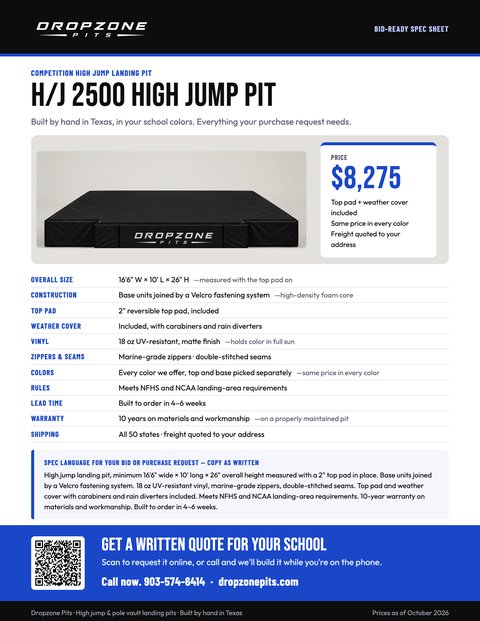
A Dropzone Pits competition high jump pit starts at $5,250. That is a 16'6" × 8' pit, built to order in your school colors, with a 2" reversible top pad and a heavy-duty weather cover in the price.
It meets NFHS, NCAA and World Athletics requirements. It carries a 10-year warranty against manufacturing defects. It takes four to six weeks to build and it ships to any of the fifty states.
We publish that figure because a coach trying to write a budget line in October should not have to sit through a sales call to learn the order of magnitude. If $5,250 is not in reach this year, you will know that in ten seconds instead of ten days, and we would rather you spent those ten days on something useful.
Why "starting at"
Because a pit is built to your school, not pulled off a shelf. A program replacing a standard-size pit pays close to the starting figure. A program going deeper, taller, or adding the pieces around the pit pays more. The section below tells you which direction each choice moves the number.
What Is Actually in That Price
This is the part worth reading carefully, on our quote or anyone's. Two pits at the same headline price are not the same purchase if one of them needs $1,200 of parts before an athlete can use it.
In the $5,250 — no line items to add
Quoted with your build — not hidden, just specific to you
Two questions for any pit quote
First: are the top pad and the weather cover inside the number, or beneath it? Second: is the height you were quoted the base unit, or the overall height with the pad on? Ours are included, and every height we publish is overall.
What Moves the Price
Five things account for nearly all of the spread between a starting-price pit and a top-of-the-range one.
| Choice | Effect on price | Worth it when |
|---|---|---|
| Footprint | Largest single driver — more surface is more casing and more foam | You are already at the minimum and want margin, or your runway geometry demands it |
| Overall height | Moves with depth of foam, not with trim | You are jumping collegiate or World Athletics heights, not just high school |
| Logo or wordmark | Modest add | It is going on film, or it is the reason a booster club writes the check |
| Surrounding pads | Priced per piece | You have hard surfaces or fixed obstacles near the landing area |
| Freight | Varies by destination | Not optional — but it is a real number we give you, not a percentage we bury |
Notice what is not on that list: material grade. We build one specification. There is no economy casing, no thinner thread and no lighter zipper on a cheaper pit, because we only make the one. The full spec sheet is here if you want to check it against a bid document.
The Number That Actually Matters
A pit is a ten-year purchase being made out of a one-year budget, which is why the sticker price feels bigger than it is. The arithmetic that matters to an athletic director is cost per season.
At $5,250 over ten years, a high jump pit costs about $525 a season. Over twelve years of careful use it is closer to $440. That is less than most programs spend on a single meet's officials and transport.
Run the same arithmetic on a pit that fails in year five and the figure doubles — and the replacement lands in whichever budget year you were least expecting it. This is the whole argument for caring about construction rather than sticker price: how a pit is treated and how it was built are what decide which of those two numbers you end up with.
The expensive mistake
Buying a pit without a weather cover, or leaving the cover in the equipment room all spring. An uncovered outdoor pit can lose most of its useful foam life in four or five years. It is the cheapest thing on the list and the one that decides everything else.
Writing It Into a Budget or a Bid
If you need to get this in front of a business office, these are the lines that usually have to be there.
- Equipment line, not a service line — a landing pit is capital equipment with a multi-year life, which usually puts it in a different pot than consumables and often a different approval path.
- One vendor, one number — ask for the pit, the pad, the cover and freight on a single quote so the business office is not reconciling three invoices against one PO.
- Lead time in writing — four to six weeks from order. Put the date on the requisition so nobody schedules the season opener against a pit still on the line.
- The warranty term — ten years against manufacturing defects. Some approval processes weight this and most people forget to include it.
- Tax status and terms — your district will have a form for this. Ask for it at quote time, not at invoice time.
Fall order, spring season
The most common pattern we see: a budget clears in the fall, the order goes in, the pit ships in four to six weeks, and the program opens the season on it. If your money moves in October, you are not too late for March. Ask for a quote and put a real number in the request.
When You Should Not Buy a Pit at All
Sometimes the honest answer to a pit question is a $400 part. If your foam still compresses and pushes back and what has actually failed is a cover, a top pad or a zipper, replace the part and keep the pit.
- Run the check first. The 60-second pit check will tell you whether you are looking at a repair or a replacement, and it costs nothing.
- Then price the part. Covers, top pads and hardware are on the replacement parts page. We will build a cover to fit a pit we did not make.
- Call if you are not sure. 903-574-6414. Describe what you felt when you pressed the middle. Someone who builds these will tell you straight, including when the answer is not a sale.
Get Your Number
Build the pit in your colors, see it, and send it over with your dimensions. You will get a real quote back within one business day — not a brochure and not a call-back to qualify you.