The Number, Up Front
A Dropzone Pits competition pole vault landing system starts at $14,500. That is a 19'9" × 20'5" pit built to order in your school colors, with a 2" reversible top pad and a heavy-duty weather cover in the price, at 28" or 32" overall height.
It meets NFHS, NCAA and World Athletics requirements. It carries a 10-year warranty against manufacturing defects. Four to six weeks to build, ships to any of the fifty states.
Vault pit pricing is usually the most guarded number in this business, and it is the one an athletic director most needs before a budget meeting. So there it is.
Why "starting at"
Every vault pit is built to a specific runway. Height, footprint, the collar geometry your box needs and how much surrounding padding your facility requires all move the figure. Nothing about it is a secret — the sections below tell you which way each choice pushes.
Why It Is Roughly Three Times a High Jump Pit
Because it is roughly three times the object. This is the question we get most often and the answer is not complicated.
| High jump | Pole vault | |
|---|---|---|
| Width | 16'6" (5.03m) | 19'9" (6.0m) |
| Depth | 8' (2.44m) | 20'5" (6.22m) |
| Overall height | 24–30" | 28" or 32" |
| Starting price | $5,250 | $14,500 |
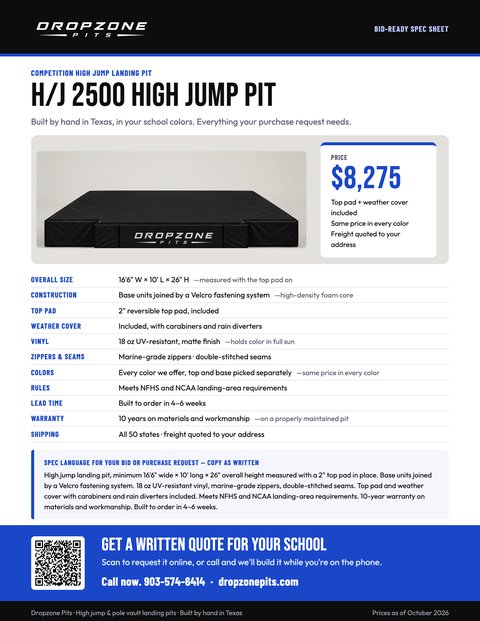
A vault pit carries close to three times the landing surface in a deeper build, and it has to accommodate the box collar and bumper geometry that high jump simply does not have. Same materials, same stitching, same zippers, same shop — considerably more of it. What a high jump pit costs covers that side.
What Is Actually in That Price
Read this carefully on our quote or on anyone's. Two vault pits at the same headline number are not the same purchase if one of them still needs a cover, a pad and a collar before anybody can compete on it.
In the $14,500 — no line items to add
Quoted with your build — required equipment, not upsells
Do not leave these off the requisition
The box collar, front bumpers and standard base pads are required equipment, not accessories. A cracked collar or a missing bumper can cost you at inspection even when the landing pit itself is perfectly sound. Price them with the pit, on the same quote, in the same budget year — not next year.
Two questions for any vault pit quote
First: are the top pad and the weather cover inside the number, or beneath it? Second: is the height quoted the base unit, or the overall height with the pad on? Ours are included, and every height we publish is overall.
What Moves the Price
| Choice | Effect on price | Worth it when |
|---|---|---|
| Overall height (28" vs 32") | Significant — height is foam depth across a very large footprint | You compete at collegiate or World Athletics level, or you host meets that do |
| Footprint beyond standard | Largest driver of all — area multiplies quickly at this size | Your runway geometry or meet-hosting requirements demand it |
| Collar, bumpers, base pads | Priced per piece | Always. This is required equipment |
| Logo or wordmark | Modest add on a surface this size | It is on film every home meet, which for vault it usually is |
| Freight | Varies by destination — a vault pit is a large freight item | Not optional. We give you the real number rather than a percentage |
What is not on that list is material grade. We build one specification and there is no cheaper version of it. The full spec sheet is written so you can drop it into a bid document.
The Number That Actually Matters
A vault pit is a ten-year asset bought out of a one-year budget, which is exactly why the sticker shock is out of proportion to the real cost.
At $14,500 over ten years, a pole vault pit runs about $1,450 a season. Over twelve years of careful use it is closer to $1,200. Spread across a vault squad, that is a smaller per-athlete number than most programs spend on poles.
Run it again on a pit that fails in year five and you have doubled the cost and put the replacement in a budget year nobody planned for. Which of those two numbers you land on comes down to construction and to how the pit gets treated — mostly whether it gets covered.
Writing It Into a Budget or a Bid
At this figure a vault pit usually goes through a formal approval, sometimes a bid. These are the lines that need to be on the paperwork.
- Capital equipment, not consumables — a ten-year asset generally sits in a different pot, with a different approval path, than anything that gets used up in a season.
- Pit and required surround on one quote — pit, top pad, cover, collar, bumpers, base pads and freight. One vendor, one number, one PO to reconcile.
- Overall heights, stated as overall — write the height into the spec as the overall height with the pad on, so two bids can actually be compared.
- Governing body named explicitly — NFHS, NCAA or World Athletics. It changes the minimum and it changes the price.
- Lead time and warranty term in writing — four to six weeks from order, ten years against manufacturing defects.
Fall order, spring season
Budget clears in the fall, order goes in, pit ships in four to six weeks, program opens the season on it. If your money moves in October you are not too late for March. Ask for a quote and give us your runway dimensions and governing body.
When You Should Not Buy a Pit at All
Sometimes the answer to a vault pit question is a collar and a set of bumpers, not fourteen thousand dollars.
- Run the check first. The 60-second pit check separates a repair from a replacement, and it is free.
- Then price the parts. Covers, top pads, collars, bumpers and hardware are on the replacement parts page. We will build a cover to fit a pit we did not make.
- Call if it is ambiguous. 903-574-6414. Describe what you found. You will get a straight answer, including when the answer is not a sale.
Get Your Number
Build it in your colors, then send it over with your runway dimensions and your governing body. A real quote comes back within one business day.